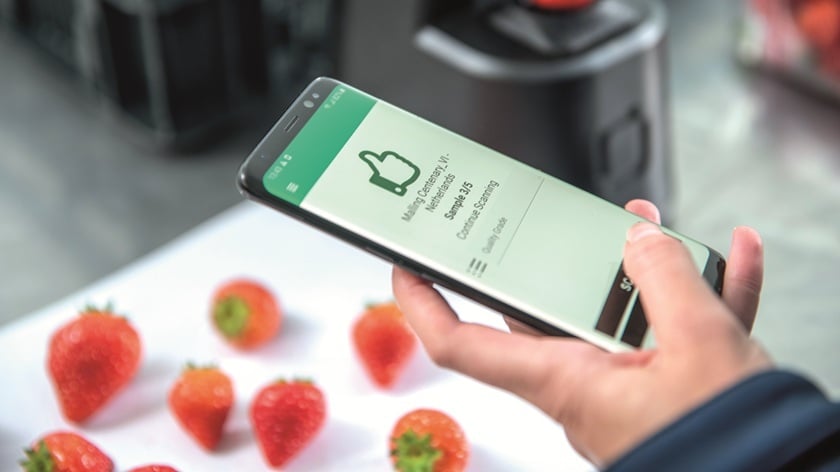
Strawberry quality insights
Strawberries are among the most delicate and time-sensitive fruits in the supply chain. Their naturally short shelf life leaves little room for slow, inconsistent, or inaccurate quality decisions. Yet most operations still rely on manual visual inspections that are subjective and operator-dependent, or on destructive sampling methods that require cutting fruit to measure sugar content.
The result is wasted product, inconsistent grading, and decisions made on incomplete data. OneThird replaces this with fast, objective, non-destructive quality assessment that measures important parameters without slowing your line or losing a single berry.
From Brix to visual defects to shelf-life prediction, OneThird gives you the complete quality picture for every batch.
.jpeg?height=2000&name=OneThird%20QC%20scanner%20-%20strawberry%20(2).jpeg)
Non-destructive Brix assessment
Sugar content is one of the most important quality indicators for strawberries, and also one of the hardest to measure at scale. Traditional Brix testing requires cutting the fruit, which means destroying the product you are trying to assess and still only sampling a fraction of each batch.
OneThird uses NIR (near-infrared) spectroscopy to measure Brix non-destructively. Light is sent into the berry, and the way it is absorbed reveals the internal sugar content. Because you can measure larger volumes, you get a statistically representative picture of your batch. Something manual sampling simply can't match. And every berry tested can still be sold.
This means you can measure more fruit, more often, without any yield loss from the quality control (QC) process itself.
-1.jpg?width=2000&name=OneThird%20Visual%20Inspection%20-%20strawberry%20(2)-1.jpg)
Visual inspection
Manual visual grading is slow, inconsistent, and scales poorly. What one operator flags, another may pass. OneThird's AI-driven visual inspection technology evaluates every berry against objective criteria, and is up to ten times faster than manual methods.
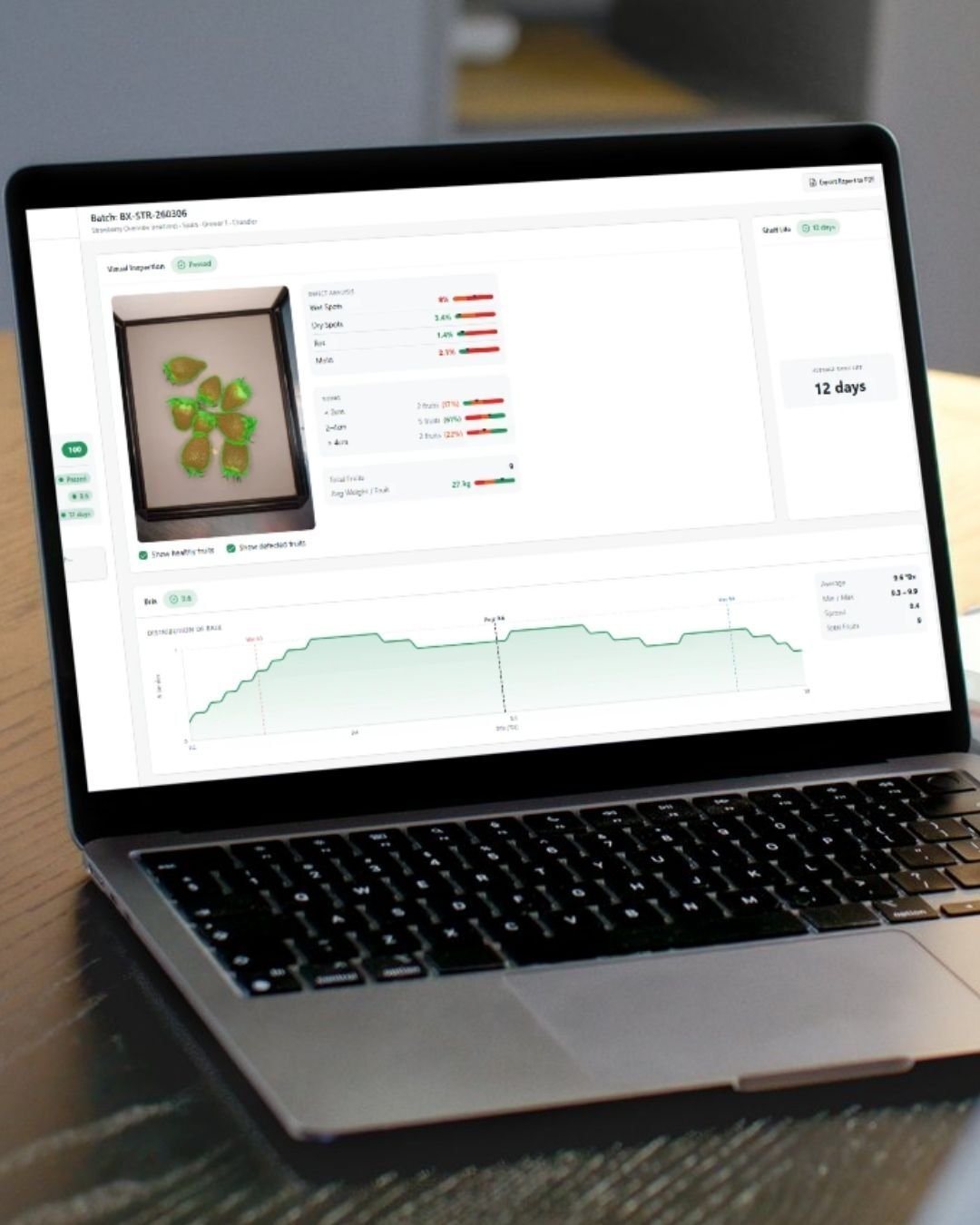
One photo is all it takes. The software counts every berry, determines individual size and size categories, and automatically flags defects like wet spots, dry spots, mold, white shoulders, misshapen berries, and discoloration. Results are instant, and matched directly against your customer specifications, so you know on the spot whether a batch passes and can move on to the rest of your QC.
.jpeg?width=1024&height=768&name=Strawberry%20-%20quality%20control%20-%20OneThird%20(1).jpeg)
Shelf-life prediction
Shelf life is a commercially important quality parameter for strawberries, and the hardest to predict reliably. Most supply chain decisions are based on averages or assumptions, not actual measured data. This leads to unnecessary rejections, suboptimal routing, and avoidable food waste.
Tracking shelf life is nothing new. But the answer typically only comes days later, when the batch has been sitting and options are already limited. OneThird predicts shelf life at the moment of measurement, based on the actual internal quality of your berries. So you can make routing and allocation decisions immediately, getting products to the right destination at the right time, maximising freshness and minimising waste.
Shelf-life predictions improve over time as the model learns from your specific varieties, growing conditions, and supply chain patterns.
Your data where you need it
No more manual transferring data into your own system. All quality insights from the scans and the pictures give an instant view of whether a batch meets your personal specifications. The data is also visible directly in your OneThird dashboard.
Immediate access to quality results gives quality managers insights into daily operations to make better allocation decisions or analytical reports to spot trends and insights on quality. Comparing varieties, suppliers, parameters, and much more. Prefer to work in your own system? Results can be transferred automatically into your QMS via API.
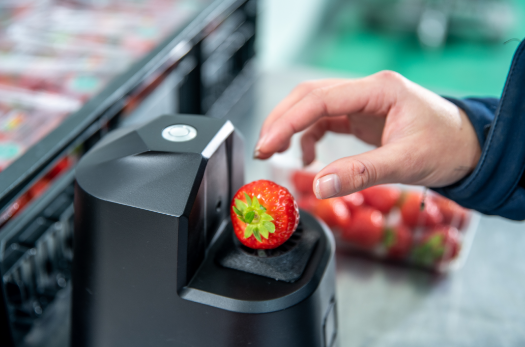
Traditional QC costs you fruit. Ours does not
On average, destructive testing costs a medium-sized strawberry grower up to 26 kilos of strawberries due to quality control each year. For large growers, that figure rises to up to 155 kilos annually, This is a significant and entirely avoidable yield loss.
With OneThird's nondestructive scanner, every berry tested can still be marketed. Our platform saves up to 90% of the fruit you would otherwise lose to the QC process itself.
On top of the time value, it brings you. Implementing our quality assessment technology doesn't interfere with your current QC process. Within two months, you are fully ready and operating.